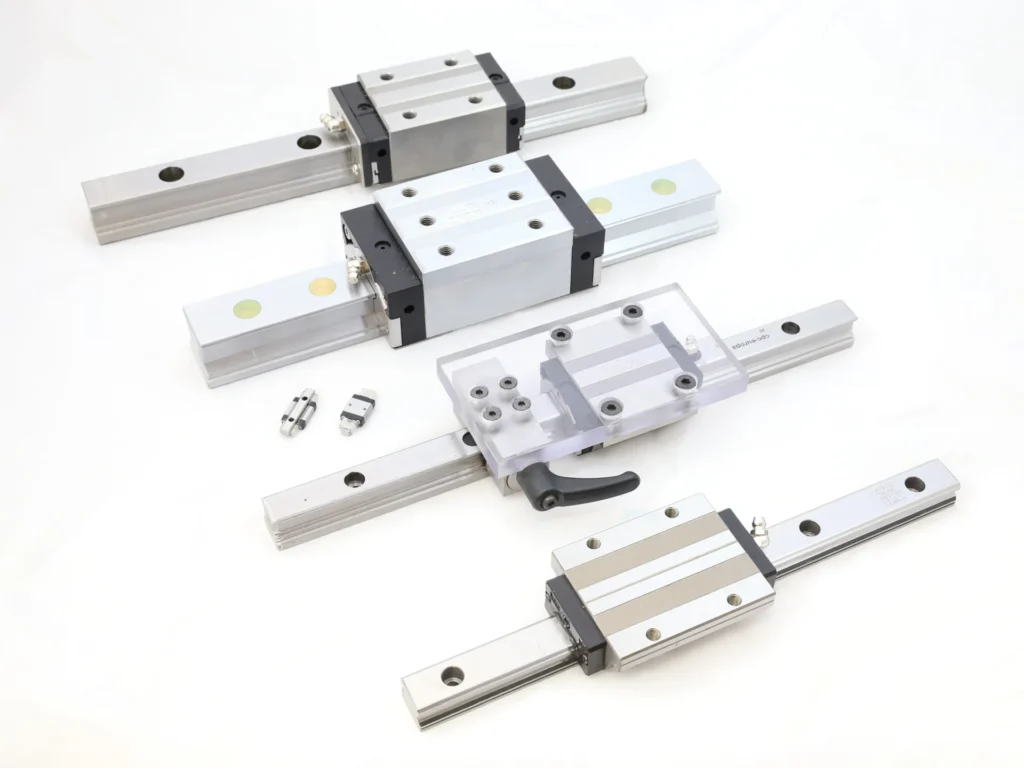


Linear motion guides: High-precision linear bearings for CNC, manufacturing technology & industry
The linear motion guides from PGM Motion are linear bearings designed for maximum precision and rigidity, with a construction optimized for the rolling motion of recirculating elements.
These systems offer numerous advantages: low friction, no sticking or slipping, and smooth longitudinal movement even under high loads, making them the ideal solution for demanding applications in manufacturing technology, mechanical engineering, plant engineering, and especially CNC machines.
Whether used in general industrial applications or as a precision-guiding axis in high-accuracy systems, selecting the right linear rails and linear guide configuration can significantly reduce costs, installation effort, and potential operational issues later on. With nearly 30 years of experience in this field, we understand the advantages and limitations of the different guide types and how to design them for optimal performance.
Our experts support you from selection and installation to commissioning – ensuring maximum precision and service life for your linear motion guides.
Technical features and design of our linear motion guides
- Maximum precision & rigidity: Thanks to ball- or roller-guided elements and precision-ground raceways, linear motion guides provide optimal guidance and excellent repeatability.
- Low friction, no sticking or slipping: The precisely engineered carriage design ensures low-friction movement and prevents play in the system – crucial for applications requiring high dynamics and accuracy.
- Smooth longitudinal motion under load: Even under high forces or accelerations, our systems ensure stable and uniform motion – particularly important in CNC machines and positioning systems.
- Flexible range of applications: From heavy manufacturing equipment to sensitive precision machinery, the appropriate configuration of linear guides allows the solution to be perfectly adapted to the specific application.
Why choose linear motion guides from PGM Motion?
- Specialization & experience: With nearly 30 years of experience in linear guide technology, we understand the requirements of both custom machine building and series production machinery.
- Efficiency through intelligent selection: Careful design and selection of the appropriate guide type saves installation time, post-adjustments, and long-term maintenance costs in both standard and high-end applications.
- Wide product portfolio: Whether standard linear bearings or custom-engineered solutions, we cover the full spectrum – from robust industrial guides to high-precision recirculating ball guide systems.
- Integration into CNC and manufacturing technology: Our systems integrate seamlessly into modern production lines and CNC machines – from single-axis applications to complex multi-axis systems.
Have your system reviewed by our engineering team. We calculate load capacity, preload, and rail length individually for your requirements.
Contact us now via our contact form or by phone for a free design consultation, or download the main catalog for CPC linear motion guides directly.
Overview of application areas
- CNC machines: Axes, gantries, or table systems with extremely high accuracy requirements.
- Manufacturing technology & automation: Longitudinal and transverse movements in assembly systems, pick-and-place modules, or handling systems.
- Positioning systems & precision machinery: Require rigid guidance, minimal play, low friction coefficients, and long service life.
- Industrial systems with high loads: Robustness, ease of maintenance, and durability are key factors in these environments.
Are you planning a new linear motion system or the modernization of your CNC machine? The right selection of a linear motion guide depends on load capacity, rigidity, environmental influences, and installation conditions.
On request, we can provide a service life calculation based on the real load profiles of your system.
Our engineering team supports you in selecting and designing the right linear motion guide – including CAD data and calculation services.
Submit your non-binding inquiry now or download the catalog.
FAQ – Frequently Asked Questions about Linear Motion Guides
1. How do I ensure that two linear rails are mounted parallel without creating play?
Precise parallelism is critical for the service life and accuracy of a linear motion guide. Even small deviations can lead to increased wear, binding, or uneven running friction.
Installation must therefore follow measurement and alignment procedures rather than standard rail mounting.
Define a reference rail: One of the two rails is mounted as the fixed reference.
Fine-tune the second rail: The second rail is aligned to the first using dial indicators or laser alignment systems.
Follow the correct tightening sequence: Initially tighten the screws only lightly, then move the carriage several times across the full stroke to allow it to settle into its natural running path. Only then should the screws be fully tightened.
Verify parallelism: High-quality manufacturers such as THK or Bosch Rexroth often specify tolerances of < 2 µm per 100 mm of travel.
This approach minimizes internal stresses and running differences, significantly extending system service life.
2. What can I do if my carriages jerk or stick during initial operation?
“Sticking” a jerky start of motion is one of the most common issues. It is usually caused by insufficient lubrication, contamination, or inaccurate alignment.
Causes & solutions
Uneven mounting surface: Any irregularity or debris between the rail and the base surface can cause running resistance.
Dry carriage: New guides are often supplied only with corrosion protection oil rather than operating grease. Apply a suitable lubricant (e.g., lithium- or molybdenum-based grease) before commissioning.
Distorted installation: Excessive screw tightening can deform the rail and cause the carriage to bind. Tighten screws gradually and evenly using small torque increments.
Regular cleaning and relubrication significantly extend the service life of linear bearings.
3. How does an inaccurate mounting rail affect guide performance?
An inaccurately mounted or warped rail directly impacts straightness, friction, and service life of the entire linear guide system. Even minimal irregularities of a few micrometers per 100 mm can create noticeable resistance.
Consequences
Increased rolling resistance → motor requires higher torque
Irregular motion → loss of accuracy, especially in CNC machining
Point loading on balls → premature wear or raceway damage
Acoustic vibrations or humming during movement
Recommended measures
Mount rails on milled or ground surfaces
Use dial indicators or precision straightedges for verification
Perform a test run after tightening to detect residual deviations
4. When should a ball guide be preferred over a roller guide?
Both systems belong to the category of linear guides but differ in function and typical application.
Roller guides
Higher load capacity
Greater rigidity
Ideal for machines requiring high stiffness or heavy loads
Ball guides
More compact and lightweight
Lower friction coefficient
Ideal for smaller CNC machines, 3D printers, or applications with frequent direction changes
In short: applications requiring maximum rigidity and load capacity (e.g., machine tools) benefit from roller guides, while dynamic lightweight systems benefit from ball guides due to smoother motion and reduced weight.
5. How can I prevent tolerances or play from appearing after installation?
After tightening the screws, rails can slightly distort, which may introduce play into the system.
Recommended procedure
Temperature control: Perform installation at a stable room temperature (approx. 20 °C) to prevent thermal expansion effects.
Simultaneous mounting: Install both rails together rather than sequentially.
Tightening sequence: Tighten screws diagonally (star pattern) and gradually increase torque.
Run-in verification: After installation, perform several test cycles, measure play, and readjust if necessary.
Document measurements: Record values for parallelism, running resistance, and tolerances.
Following these steps minimizes the risk of positioning errors or bearing damage – particularly important in CNC machines and precision measurement systems.