


Design of linear guides and rolling bearings: Precision engineering services for your application
The design of linear guides and rolling bearings is critical for the precision, service life, and energy efficiency of your machine.
With PGM Motion’s engineering service, you receive a calculation-based solution for load capacity, friction behavior, and service life, fully tailored to your specific application.
You provide your motion profiles, load requirements, and lifetime specifications -we take care of the rest: from selecting the appropriate linear guide system and optimizing the linear bearing, to recommending the ideal ball screw assembly or rolling bearing concept.
As part of modern linear motion applications – such as CNC machines, heavy-duty axes, or automated positioning systems the correct design of linear guides, drive systems, rolling bearings, and profile rail guides is becoming increasingly critical. Choosing the wrong components can lead to increased friction, premature wear, backlash, or positioning inaccuracies resulting in higher costs or even system failure.
With our service, we help you systematically define all relevant parameters and translate them into a robust and reliable system design including recommendations for mounting, interfaces, and control integration.
Why professional design of linear guides and bearings is important
- Optimal combination of guide and bearing systems:
In many machines e.g. linear guides are combined with drive systems and control units. To ensure smooth interaction, forces, moments, and motion profiles must be properly matched. Incorrect design often leads to premature wear or backlash. - Service life and operational reliability:
A precise design of the linear bearing or rolling bearing system reduces the risk of unexpected wear or failure. This is especially critical in demanding applications such as CNC machines or high-precision positioning systems. - Efficient use of assembly space and materials:
A well-engineered selection helps answer key questions regarding linear guides, plain bearings versus roller bearings, and axis dimensions. This results in savings in space, weight, and cost. - Interface integration:
We also consider ball screw assemblies, guide systems, and motor interfaces to ensure seamless system integration. - Documentation and traceability:
Our engineering design includes transparent calculations, comparison options, and clear recommendations – ideal for design, testing, and traceability.
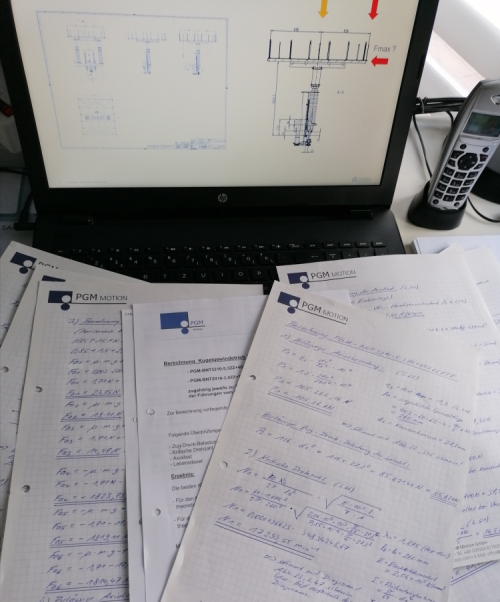
Technical expertise & verified quality
Our engineers design rolling bearing systems in accordance with ISO 281 / ISO 76, and linear systems based on ISO 14728-1 and -2, supported by FEM-based simulations for load and rigidity analysis.
All calculations are fully documented and provided in CAD-compatible formats (STEP, IGES).
Upon request, we also provide test certificates, material certifications, and service life predictions.
Scope of services for system design
- Motion requirement analysis:
Definition of stroke, track length, speed, acceleration, as well as breakaway and holding forces. - Load analysis:
Evaluation of radial, axial, and moment loads acting on the guide and bearing system to quantify the load spectrum. - Installation space & kinematics analysis:
Assessment of linear guide length with drive system, travel ranges, mounting surfaces, and interfaces. - Component selection:
Recommendation of linear guides, linear bearings, guide system types, ball screw assemblies, or lead screws. - Rolling bearing design:
Selection of bearing types, tolerances, preload, materials, and service life calculation. - Assembly & control recommendations:
Guidance on system layout, final control-related calculations, and drive integration. - Documentation:
Comprehensive report including calculations, lifetime evaluation, safety factors, and cost-performance analysis.
We analyze your application and develop a preliminary engineering design, enabling you to quickly obtain a reliable system concept for linear guides, bearings, and drive systems.
FAQ – Frequently asked questions about the design of linear guides and bearings
1) What information is required for the design of a linear guide or bearing system?
For precise system design, detailed application data is required, including loads (axial, radial, moments, including duration and position), travel distance, speed, duty cycle, mounting orientation, environmental conditions (e.g., temperature, dust, humidity), and the required service life.
This data enables the targeted selection of the appropriate guide system and bearing concept – such as ball recirculating guides, cross roller guides, or plain bearings and ensures optimal adaptation to the specific machine environment.
2) What is the design process for linear guides and bearings at PGM Motion?
After receiving your technical data, we analyze load conditions, installation space, and precision requirements. This is followed by a calculation-based design of linear and rolling bearings, taking into account friction, rigidity, and service life.
We compare different solution approaches (e.g., plain bearings vs. rolling bearings, ball vs. roller systems) and provide a recommendation including calculation report, CAD model, and, if required, a matching drive system design.
3) How can I tell if my existing linear guide is correctly designed?
An incorrectly designed system typically shows uneven motion, increased friction, vibrations, or premature wear. Uneven load distribution between guides is also a common indicator.
At PGM Motion, we analyze existing systems, measure actual load conditions, and, if necessary, propose optimization measures or alternative guide concepts.
4) What is the difference between designing a linear guide and a rolling bearing system?
The design of linear guides focuses on motion accuracy, friction, load capacity, and rigidity along a linear path. In contrast, rolling bearing design addresses rotational or tilting movements and the associated load distribution e.h. in ball bearings, needle bearings, or thrust bearings.
Both systems must be carefully matched to ensure optimal performance and service life, especially in CNC machines or multi-axis linear systems.
5) Do you also offer services in the integration of drive systems and controls?
Yes. Upon request, we consider the integration of drive systems and control units into the design of linear guides. For example, in systems with ball screw assemblies or servo-driven linear guides.
This ensures you receive a fully integrated axis system, including documentation, system design, and recommendations for motor and control selection.